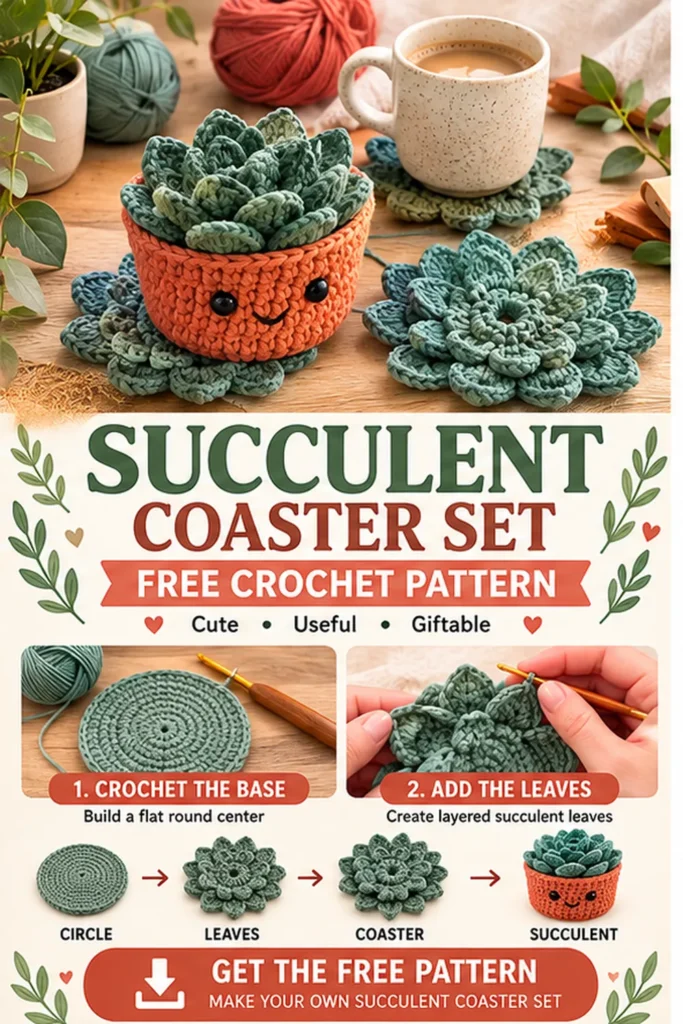
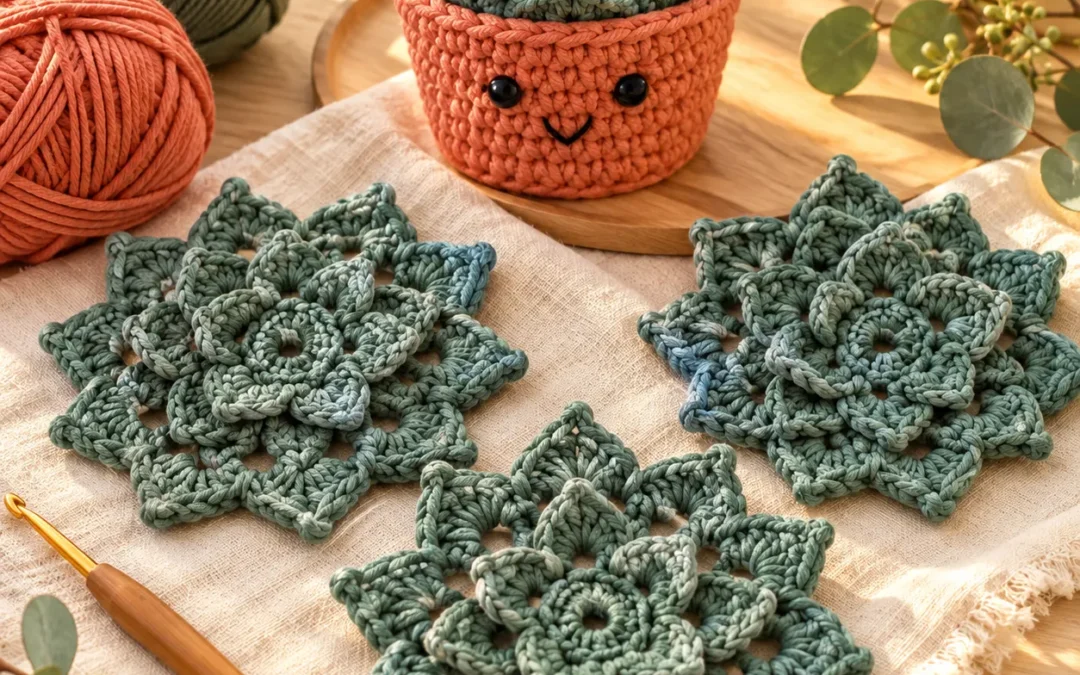
If you love crochet projects that are both decorative and useful, this Succulent Coaster Set Crochet Pattern is a beautiful one to add to your list.
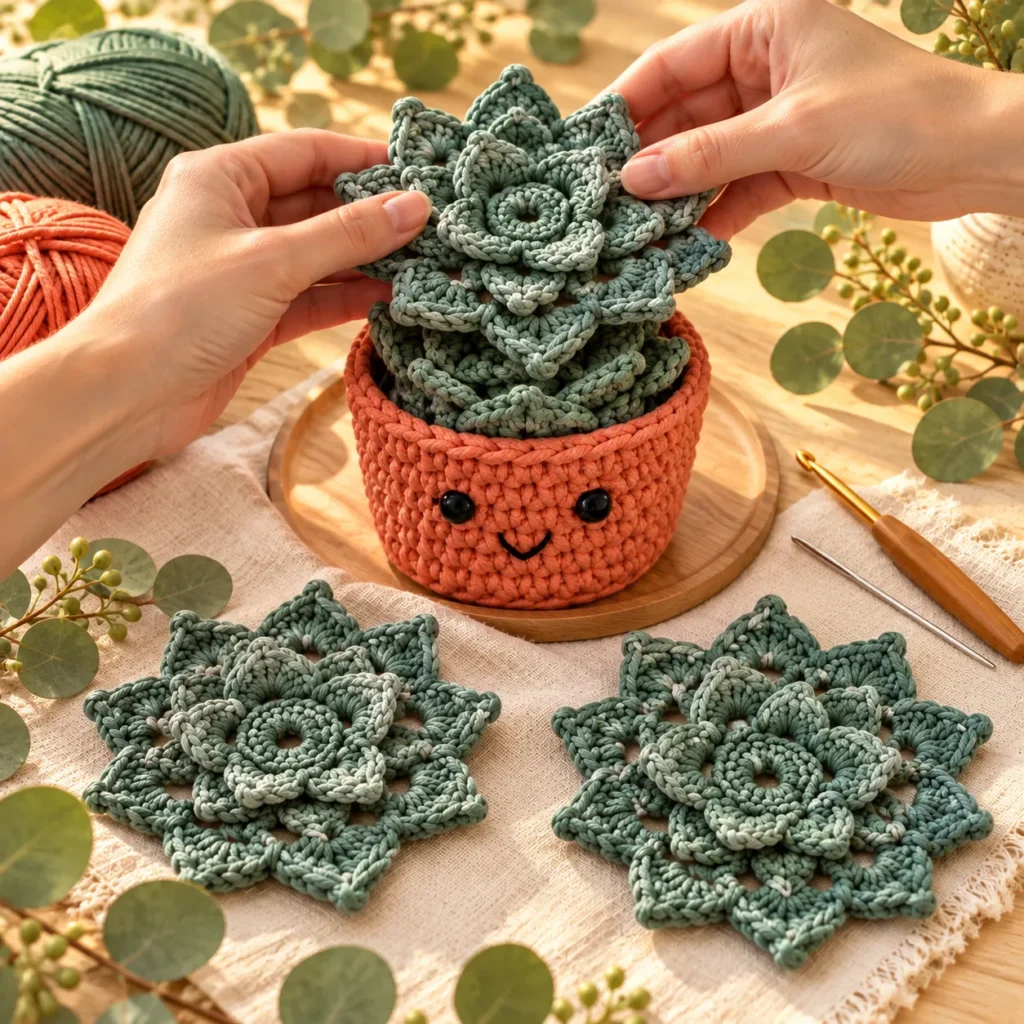
Each coaster is designed to look like a little succulent rosette when lying flat on the table. When you are finished using them, stack the coasters together and tuck them inside the matching crochet planter to create what looks like a tiny handmade succulent plant.
It is a clever project for coffee tables, desks, housewarming gifts, plant lovers, Mother’s Day gifts, craft markets, and modern home décor.
For the main version, we’ll use dusty eucalyptus green cotton yarn for the succulent leaves and a warm terracotta-coral yarn for the planter.
Pattern at a Glance
| Detail | Information |
|---|---|
| Skill Level | Confident Beginner / Intermediate |
| Crochet Terms | US terminology |
| Yarn | DK / light worsted cotton |
| Hook | 3.5 mm |
| Construction | Center-out coasters + dimensional leaves + planter |
| Coaster Size | Approx. 4½–5½ in |
| Main Stitches | MR, ch, sc, hdc, dc, tr, sl st |
| Set Includes | 3 coaster styles + holder |
Why This Succulent Coaster Set Is So Fun
The best part of this design is the transformation.
Individually, each piece works as a practical crochet coaster.
Stacked together inside the little pot, the leaf edges overlap and create the illusion of a full succulent.
The basic construction is:
CENTER → LEAF ROUNDS → SHAPE → COASTER → STACK → SUCCULENT PLANT
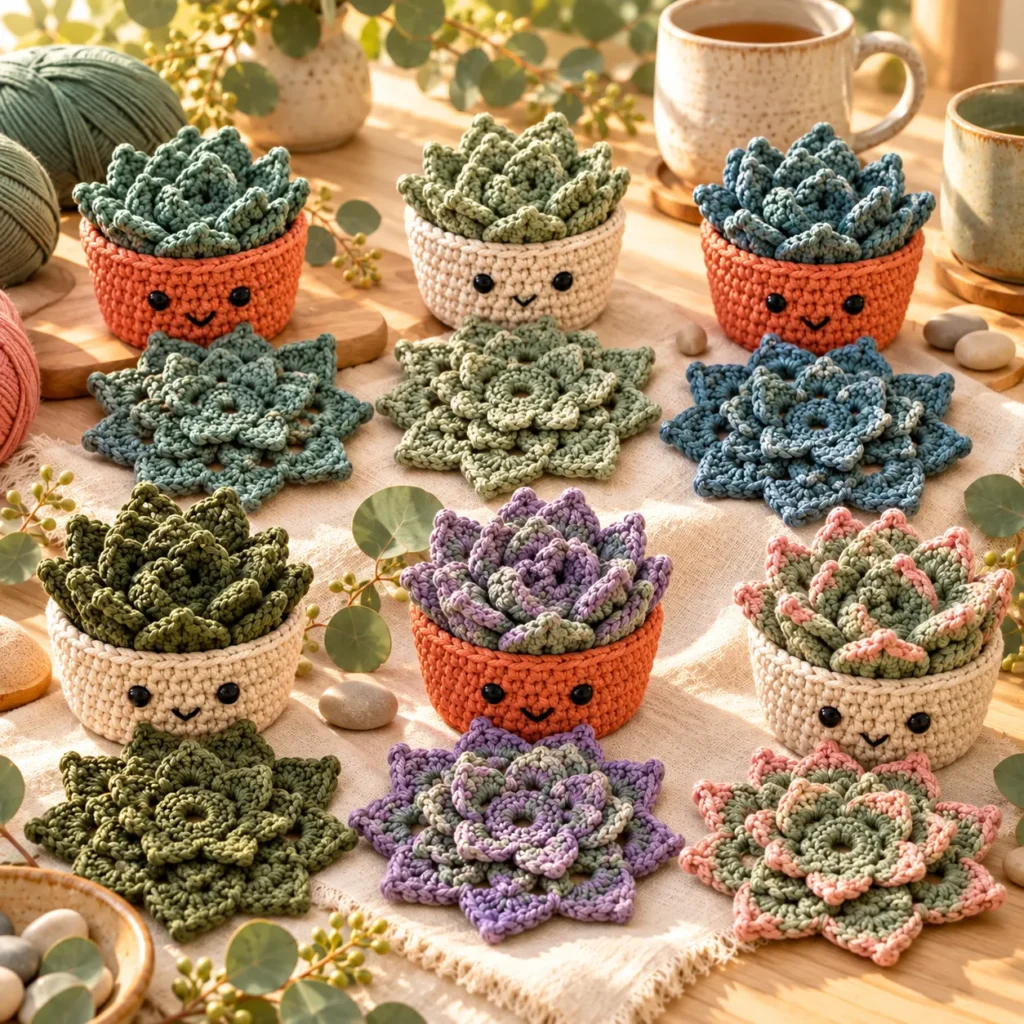
You can crochet all the coasters in one shade of green for a modern look or combine sage, eucalyptus, olive, teal, and moss for more natural variation.
Materials
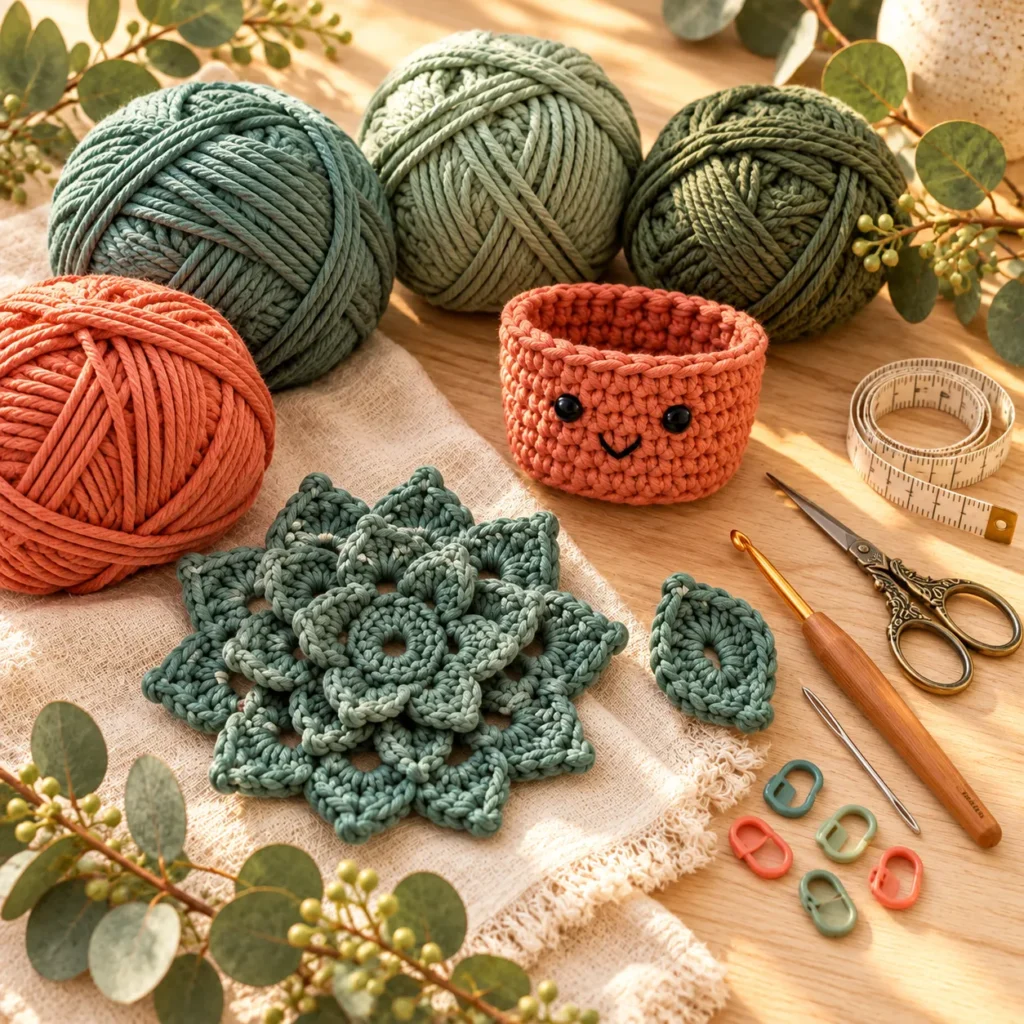
For a set of approximately four coasters plus one planter, use cotton or cotton-blend yarn.
You’ll need roughly 150–200 yards of green yarn in total and 50–70 yards for the planter.
Cotton is especially useful here because it gives the leaf points good definition and creates coasters that lie neatly on the table.
A 3.5 mm hook gives the fabric enough structure without making it overly stiff.
Abbreviations
| Abbreviation | Meaning |
|---|---|
| MR | Magic Ring |
| ch | Chain |
| sc | Single Crochet |
| hdc | Half Double Crochet |
| dc | Double Crochet |
| tr | Treble Crochet |
| sl st | Slip Stitch |
| st / sts | Stitch / stitches |
Coaster 1 – Simple Succulent Rosette
Start with dusty eucalyptus green.
Make a magic ring.
Round 1
Work:
12 dc into MR
Join with a sl st.
Round 2
Work:
2 dc in each stitch around
You now have 24 stitches.
Round 3
Work:
1 dc, inc
Repeat around.
The goal is to create a smooth flat circular foundation.

Add the First Leaf Round
The botanical look comes from working pointed leaf shapes around the edge.
Into the next stitch or working space, make:
sl st, ch 2, hdc, dc, tr, dc, hdc, ch 2, sl st
This creates one pointed leaf.
Skip or move to the next suitable stitch and repeat evenly around.
Aim for approximately 8–10 leaves on the first decorative round.
Do not worry if the leaves overlap slightly.
That overlap helps create the succulent effect.
Add the Outer Leaf Round
For the next round, work behind or between the first set of leaves.
Make the outer leaves slightly larger:
ch 2, hdc, dc, tr, tr, dc, hdc, ch 2, sl st
Offset each new leaf so it sits between two leaves from the previous round.
The finished piece should remain mostly flat, but the leaves can lift slightly around their tips.
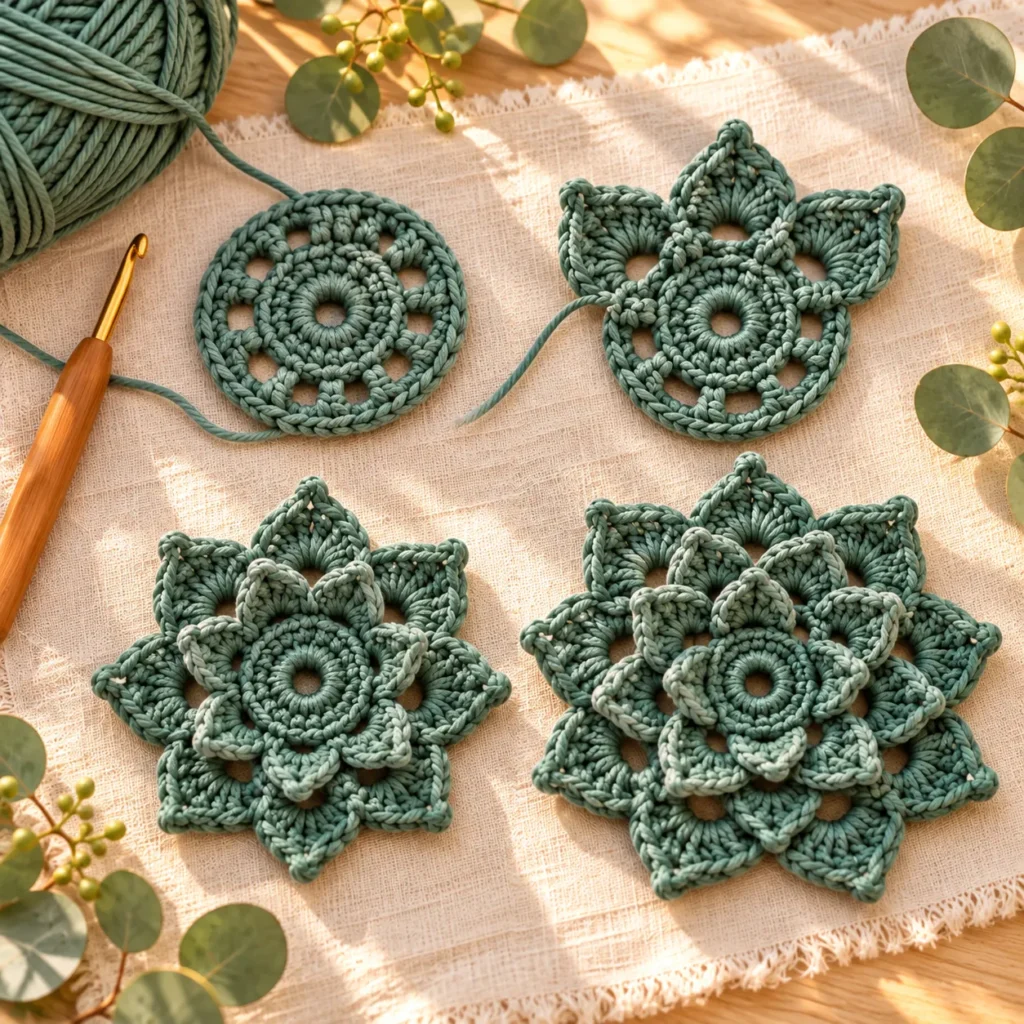
Coaster 2 – Openwork Succulent
For the second style, start with the same circular center.
After several solid rounds, add a decorative openwork round.
Try:
ch 3, skip 2 sts, sc in next st
Repeat around.
On the following round, work the pointed leaves into those chain spaces.
This version looks lighter and more lace-like.
It works beautifully beneath glasses, tea cups, or candles.
Coaster 3 – Extra-Dimensional Succulent
The third variation uses more tightly packed leaves.
Start with a smaller center and begin the leaf rounds earlier.
Use shorter inner leaves, then medium leaves, followed by larger outer leaves.
The formula becomes:
SMALL LEAVES → MEDIUM LEAVES → LARGE LEAVES
When the leaves naturally curl upward, the coaster looks almost like a real echeveria succulent.
For table use, keep the very center relatively flat so mugs remain stable.
Crochet the Planter
Using terracotta-coral yarn, make a magic ring.
Base
Work:
6 sc into MR
Then increase evenly until the circular base reaches approximately 3–3½ inches.
Sides
Once the base is the correct width, stop increasing.
Work:
sc in each stitch around
Continue upward for approximately 2½–3 inches.
For a slightly flared flowerpot shape, add a few evenly spaced increases during the final rounds.
Rim
Finish with one or two rounds of hdc or reverse single crochet for a firmer rim.
The planter should be large enough for the stack of coasters to sit snugly inside.
Make the Coasters Look More Realistic
The final shaping is what makes these pieces especially attractive.
Use your fingers to curl some leaf tips slightly upward.
Leave other leaves flat.
Rotate the outer leaves naturally rather than keeping every point perfectly aligned.
You can also combine two green shades in a single coaster.
For example, make the center dark olive and the outer leaves dusty eucalyptus.
That subtle tonal variation makes the plant look more realistic.
Succulent Color Ideas
Succulents come in much more than basic green.
Try combinations such as:
Eucalyptus + Sage
Soft botanical neutrals.
Blue Green + Olive
A cooler modern palette.
Sage + Dusty Pink
Inspired by pink-tipped succulents.
Deep Olive + Moss
Rich earthy tones.
Lavender + Sage
A fantasy botanical version.
Terracotta + Olive
Warm desert-inspired colors.
Cream + Sage
Minimal farmhouse style.
How to Use the Succulent Coasters
These are especially nice on coffee tables because they look decorative even when they are not underneath a drink.
Pull one coaster from the planter whenever you need it.
Afterward, return it to the stack.
Because each coaster has leafy outer edges, stacking them at slightly different angles creates a much fuller succulent appearance.
You can also use individual coasters beneath candles, small plant pots, jewelry dishes, or desk accessories.
Make a Gift Set
This project works especially well as a handmade gift.
Crochet four or six coasters and one holder.
Stack them inside the pot and tie a small kraft-paper tag around the planter.
Good occasions include housewarmings, birthdays, Mother’s Day, teacher gifts, plant-lover gifts, and hostess gifts.
Make a Smaller Version
Use sport-weight cotton yarn and a 2.5–3 mm hook.
Smaller succulent motifs can become:
coasters for espresso cups, ornaments, bag appliqués, refrigerator magnets, garlands, or gift toppers.
Make a Larger Succulent Mat
Use worsted or chunky cotton and a larger hook.
Continue the circular center for several additional rounds before adding the leaves.
A larger version can work as a plant-pot mat, candle mat, table centerpiece, or decorative trivet.
Tips for a Professional Finish
Keep the center of each coaster relatively flat so cups remain stable.
Offset the leaf rounds rather than stacking one leaf directly behind another.
Cotton yarn works particularly well for crisp points.
When making a set, use the same hook and yarn weight so all coasters fit neatly inside the planter.
Block the flat center lightly, but avoid flattening the leaf tips completely.
Frequently Asked Questions
Is the Succulent Coaster Set beginner friendly?
A confident beginner should be comfortable with the circular base. The layered leaves require a little more stitch placement awareness.
What yarn is best?
Cotton or cotton-blend yarn gives the best combination of structure and stitch definition.
How large should each coaster be?
Approximately 4½–5½ inches works well for most mugs and glasses.
Can I make all the coasters identical?
Yes. A monochrome set looks especially modern.
Do I need the planter?
No. The coasters work perfectly on their own, but the holder makes the project much more distinctive.
Can I use the planter for a real plant?
This crochet holder is primarily decorative and designed to store the coasters rather than hold soil or water.
Save This Succulent Coaster Set Crochet Pattern
Save this Succulent Coaster Set Crochet Pattern to Pinterest for your next botanical crochet project.
With layered crochet leaves, practical coasters, and a clever little planter holder, it is one of those projects that looks decorative even when it is not being used.